May 17, 2012

[The 1st step toward becoming a bilingual CATIA specialist] バイリンガルのCATIA使いへの第1歩

NOTE: This material is intended to be written for people who want to know about the very basics of CATIA V5 while learning some Japanese terms. It is also intended to be read among Japanese CATIA specialists who want to study English.
The following is only an introduction, a very beginning to CATIA, so it might not be helpful if you are expecting any tips on CATIA when you operate it.  But hopefully it might help someone wishing learn some specific terms in Japanese and English.

Here's the word list:


Workbench (ワークベンチ):

Creating geometries in CATIA V5 is to work in a workbench. Any 2D or 3D shape will be created in a workbench with various icon functions. 

There are different functions in each workbench in order to create a shape.


The major workbenches are:

1.    Sketcher - スケッチャー

2.    Part Design - パート・デザイン

3.    GSD (Generative Shape Design) - ジェネレーティブ シェイプ・デザイン

4.    Assembly Design - アセンブリ・デザイン

5.    Drafting - ドラフティング


Specification tree (仕様ツリー):

Every action you have taken in CATIA will be logged on the tree structure displayed on the screen. This is called the “specification tree” (仕様ツリー) and it looks like this:

Users will have to be conscious of this tree structure all the time because it will be important to know how the data was created. Visualizing the history like this allows a user or other users to modify the data when you need to. 

If the specification tree is not managed well, you or other people will be in trouble the next time you are at it. You might have to say, “Where the heck do I have to get back?? I can’t modify it!!” - It is almost like when you don't keep your room organized, and go to school in the morning leaving your locker room key at home. You call your mom from school later but she can't find it. She says your room is messy; she has no idea where to find it. Both you and your mom might be upset and you would ruin the day. (This is what my daughter did about a year ago ….)


Users/companies are always thinking about reducing the time of work and cut the cost. Being organized here on this specification tree is a very important factor to keep your modelling process more efficient and productive.


Feature/ Element (フィーチャー/ 要素):

In many cases, a 3D geometry will be created from a 2D sketch.

Let us create a geometry like this, for example.


This is how you create it:

1. Go to the [Sketcher] workbench.

2. Create a [Profile] like this in the [Sketcher] workbench.


3. The [Sketcher] workbench is intended to create 2D profiles only, so you will have to go to another workbench to make it 3-dimensional. Press the [Exit] icon.


4. When you exit the [Sketcher] workbench, you will be brought to either the [Generative Shape Design] workbench or the [Part Design] workbench. They are both capable of creating 3D geometries.


5. Let’s suppose you are in the [Part Design] workbench now. What you may want to do is create a 3D geometry by extruding the sketch you have just created.


In order to extrude a 2D sketch, select the [Pad] icon. (This icon exists only in the [Part Design] workbench.)


The specification tree will look like this:
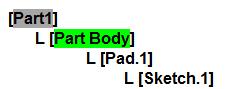


Among the users of CATIA, the terms such as [feature] and [elements] are used quite often. In this case, [Pad.1] will be called a feature.


If you make a hole on this geometry, [Hole.1] will be added in the specification tree and it will also be called a feature (フィーチャー).


The specification tree, by the way, will be displayed like this:


There is not much to distinguish with it but a feature (including [Pad], [Hole], etc.) can also be called an element (要素).


Part/ Product (Assembly)

When multiple geometries will be created, they can be managed & treated as 1 [Part] file, or as 1 [Product] file (an assembly file) with multiple [Part] files in it.


[Example 1:]

If 2 geometries will be created and will be managed in 1 [Part] file, the specification tree will be displayed like this:


[Example 2:]

If 2 geometries will be created and be managed in 1 [Product] file with multiple [Part] files, the specification tree will be displayed like this:


[Example.1] and [Example.2] are two different things. They are more different than how they look.


#1. [Example.1] is 1 [Part] file, so only 1 file will be created. Because it is 1 [Part] file, it will be treated as if it were 1 single machine part, so even if there are many [Bodies] or [features] in it with multiple geometries, constraints (e.g. fixing, positioning with coincidence/ offset, or contacting) will not be applied in order to define relationships between one [Body] and other. But it is simpler than a [Product] file to save and manage data, since it is 1 single file. The [Save As] will be used to save data (just like MS Word or Power Point).


#2. [Example.2] shows that there is 1 [Product] file as the dominant product with 2 [Part] files under it. This means that 3 files (1 [Product] file and 2 [Part] files) will be created and will have to be managed. This sounds like bad news because you have to keep as many as 3 files instead of 1. - The good news, however, is that constraints (e.g. fixing, positioning with coincidence/ offset, or contacting) can be applied to these [Part] files in order to define relationships between one [Part] and other, so they will be treated like separate parts. 


For this reason, 1 [Part] file can be re-used independently if it is saved somewhere you determined. This way, you will be able to keep multiple [Part] files out there in order to manage them, and you may want to call it a parts catalog. The [Save As] command will not be used here because each file ([Product], [Part]) has to be saved with the save directory you will define respectively.

A [Product] structure (an assembly modelling) enables to be developed to kinematics (simple machanisms analysis).

Select the [Save Management] command to display the list of files that are open. In this example, the [Product] data contains 1 [Product] file and 2 [Part] files. Make sure that each file will need to have some items to be defined, such as a file name titled as [Name] and save directory titled as [Location].

May 14, 2012

[Be determined and confident] 腹を決め、自信を持って

People often (so very often) say that ever since the IT revolution has taken place, the world seems to have changed dramatically with a great speed. They also say that the speed has getting even faster along with the trend of “globalization” or “internationalization”. Living here in Japan, there is no single day that I don’t hear such a word. You can hear someone mentioning it on the morning train, in a park or a lobby when you eat lunch, or in a restaurant or a hospital you may visit.

So many people say, “It is so cool you guys speak 2 or 3 languages at home.” The way they say it is almost like they are envious for someone who succeeded in a diet to become skinnier, or the face has become to look younger.

I can’t imagine a life without speaking multiple languages. I like where I am now and I am proud of being bilingual. I think it is a great benefit for my 13-year-old daughter to live with two languages. She speaks Japanese with her Japanese friends, while using English in her school as well as at home.

I'm pretty sure, however, there will be a time when she takes it negatively about it. She might feel she belongs nowhere. It is true that my family and I feel we are different here in Japan, but we also feel the same way out there in America, too. - We are different anywhere.

When you start thinking about it, you might want to say, “It is a great tragedy!” They might imagine a situation where a spirit that has nowhere to go after its physical life, just like the “Wandering Hollander”. – But it is out of the point.

The point here is that it is not to feel inferior or superior, but to be determined to be able to accept this "in-between" status between one language (culture) and another. That is a process through which bilingual (bicultural) individuals will feel comfortable to stay where they are, and they take pride in it. – There were times when such people were really hard to live because there was more ignorance or discrimination existing than there is now today.

The globalized economy is even good news to those who are growing or have grown bilingually.

I have come to think of Darwinism. There is a key word “survival of the fittest” by Charles Darwin that describes that suitable ones will be preserved in the struggle for life. I am not saying that just bilingual individuals are the fittest, but the world has become to consider more of them.

This “In-between” position, therefore, will no longer be considered unstable, but could be a distinctive category where such people live more comfortably in order to make more possitive impact on society.

Apr 29, 2012

[Good Bye for Now, Toyota City. Hope I Will be Back Soon!!!]

I am packing my stuffs in my room at Toyota, Aichi. I have to leave this city for a family reason. The two years I spent in this place were the best career experience in my life. I was always thankful for being there, and being part of one of the greatest automakers in the world.

I worked so busily in the last day in the office. I worked on some technical support issue (it was not an easy one to handle) during the morning and somehow I made it to come up with a good thing to be a solution. I even had a translation request in the evening and I did it in a short time. I also had some more important things to do during the work hours I really appreciate I was able to work like that on the last day in that workplace. I went out to eat lunch with a couple of people in my group. I ate noodles with no soup and they were so good. It seemed like the farewell party conducted the previous day was still continuing. I was talking to some people in the office even after it was 6 p.m. I had a dinner with the leader. I truly hope I will have a chance to work with them again in the future. The culture out there is, by far, the best one I have ever been through. I am proud that I worked in that wonderful work environment, and I am proud of those great people still working out there. I am going to miss them and the work place. I want to say "Thank you so much" to all of those who concerned while I was here in Toyota city, Aichi.

Mar 12, 2012

[What is ISO26262? - Just curious]

NIKKEI ELECTRONICS is a business magazine written in Japanese. A good friend of mine here in Japan printed some 15 pages out and gave it me the other day. He did that for me because I had mentioned ISO26262 a little while back, saying “Do you know what that is all about? I’m just curious.”

The reason I was interested in this issue is because I happened to hear someone saying ISO26262 will be a mandatory package in order to sell vehicles in Europe. And I had also read from another magazine that some automakers and suppliers in Japan had not been ready for this. (I’m not exactly sure about the situation right now in February 2012.)

The following is a digest I made from the magazine article I read in Japanese. (NIKKEI ELECTRONICS, the 2011.1.10 issue)

Overview:
1. ISO26262 is a standard for systematic safety in electronic products of automobiles.
2. The reason it came into being is that another safety standard (IEC61508) had already been set out, but it was not suitable to evaluate. It was not practical.

IEC61508 vs. ISO26262:
IEC61508 was issued in 1999 in order to be a standard for electric and electronic fields. But it was not established to meet the requirements for automobile production. After some trials period, the article says, some automobile companies came to realize that IEC61508 was not suitable to implement in their automobile production systems.

[Reasons]
i) IEC61508 was originally issued for petroleum chemical plants. (It was not intended to evaluate the mass production system of automobiles.)
ii) Probabilistic theory has a lot to do with an evaluation for IEC61508. But it is out of the point.

Some automakers in Germany and France thought this standard wouldn’t work as expected, so that another one (ISO26262) should be created.

A CUSTOMIZED VERSION OF IEC61508?
So it might be natural to think ISO26262 is a customized version of IEC61508. But it is only a part of it. - ISO26262 is more like an enhanced version of IEC61508 in that another point of view was adopted besides just functional safety issues.

Problems with IEC61808:
Since IEC61808 was issued in 1999, some experts in safety measures have pointed out that it does not fit the automobile components production with the following reasons.

1. Relying on the probabilistic theory will be misleading. It may make the problem become more complex:
IEC61808 is focusing too much on the probabilistic theory in order to detect an error of an individual part. This will cause the functionality to be more complicated because an effort will have to be made to reduce the occurrence of errors. This will likely cause a problem to the whole system.

2. Part-to-part evaluation is not enough to prove safety:
Evaluation is conducted on the part-to-part level in IEC61508. Meaningful as it appears, it actually doesn’t fully prove the safety. Reliability and safety, the article says, are 2 different things. One part can have a different level of risk according to which other parts it will be associated with. Risk will not be generated from just one single part, but from multiple parts combined.

3. It is not practical:
In addition to #1 and #2, IEC61808 has another problem. It doesn’t have a concept to overview the system in order to evaluate safety. The probabilistic approach was criticized for having no academic reasoning or practicality.

Conclusion:
ISO26262 was created by referencing the system safety measure, and it was adopted in the aerospace and defense industries in the U.S. This approach has arisen and developed after the World War II. And it is more focused on macro-perspective regarding safety, where an interaction of subsystems will be evaluated. And that makes ISO26262 look differently from another existing standard, IEC61808.

Feb 5, 2012

[We are on the same boat]

I am recently reading this book “THAT USED TO US” during my lunch break. One of the authors is known to have published another book in 2005, titled as “THE WORLD IS FLAT,” where he described the globalization trend evoked by the IT revolution. He writes that “more people could suddenly compete, connect, and collaborate with more other people from more different places for less money with greater ease than ever before in the history of humankind.”

What this means is because of the IT revolution, people can be hyper-connected on the global scale, allowing them to pursue less expensive & more effective economic activities. Many jobs became possible to be outsourced overseas. This is what has happened in the U.S.A. as well as in Japan. This has caused another change in terms of how we would have to work & what our work conditions would be like.

The book describes the today’s job market can be divided into the following 3 segments:
1. Non-routine high-skilled jobs
2. Non-routine low-skilled jobs
3. Routine middle-skilled jobs


The first one “Non-routine high-skilled job” is one whose function cannot be replaced with a computer or robot, which therefore cannot be outsourced offshore. This type of work includes engineers, programmers, designers, financiers, senior executives, stock and bond traders, accountants, performers, athletes, scientists, doctors, lawyers, artists, authors, college professors, architects, contractors, chefs, specialized journalists, editors, sophisticated machine tool operators, and innovators.

The second one in a job market is a job, involving tasks that have to be done manually on the spot by a human. No robot or computer can take the place of these jobs, which therefore cannot be outsourced overseas. The authors says this type of work includes dental assistants, hair-stylists, barbers, waitresses, truck drivers, cooks, bakers, policemen, firefighters, construction worker, deliverymen, plumber, electrician, maid, taxi driver, masseuse, sales clerk, nurse and healthcare aid at a nursing home.

The third one is a job involving a lot of standardized repetitive tasks. This type of work includes factory-assembly work, number-crunching and filing in the backroom of a bank or brakeage house, routine task of reporting, transcribing, creating a Power Point presentation material for someone else.

The author says that it is this type of job that has been devastated by the merger of globalization trend and the IT revolution. It doesn’t matter if it is white-collar or blue-collar.

Summing it all up, it could be said as the following:
1. Non-routine high-skilled work becomes more lucrative.
2. Non-routine low-skilled work can pay decently, depending on the local economy and demand for the work.
3. But routine middle-skilled work will shrink or disappear.

This is not all. It is also mentioned in this book that just because you are in a “non-routine job” doesn’t mean you are safe. “If you do a non-routine high-skilled job in a routine way, your task will be subjected to outsourcing, automation, or digitization, meaning that you will lose your position with an economic squeeze.

I remember that as a child I had been told by teachers, parents, and other grownups to get good grades in order to go to a good college. If you go to college and then are hired by a good company, you will be safe.

But this has become out of date. Those adults didn’t know what the IT was, or what the globalization was like. Getting good grades at schools to work for a good company does not guarantee you will be safe.

This book also deals with an education issue in the United States. I guess many people have said already about what has been described in this book, so I’m not going to mention it here.

Instead, I want to mention what is happening here in Japan. Not much has been told about it in the English language. Here in this country, so many people (it is almost like everyone) mention the globalized economy or internationalization. These words have been like fashion. They like to mention these things as if they were chatting away about the subject of diet, beauty, gossips, etc. But nothing seems to have changed them.

As I look around in the library (where I’m writing this article), there are 20 or more Japanese highschool or junior highschool students, studying really hard. They seem to be doing the same thing as their parents had been doing. They are working so hard on their English activity drills in the same way that former generations had done but failed miserably. Most people are unable to command English even after they studied it for more than 10 years at schools. They keep studying it hours and hours each day until they successfully pass an entrance examination for college or university. They memorize enormous amount of information with having no doubt. They take all that knowledge passively. There is no chance of debating over something they study about, or of performing a presentation. I understand it is not regarded as important here. Memorizing as much as you can is what matters most. There should be no question about it.

It seems like they still believe just passively inputting much information is the only way to be competitive in the world. But the fact is they are extremely introvert and less communicative, if they are not with close friends or in their small group. It even looks it is a taboo to openly talk with someone outside their small group.

Just like more innovation should be powered by better education for every American, another kind of innovation must be applied to every Japanese individual.

This book makes me think a lot because I think I have experienced with every type of jobs described above, but I realize I am vulnerable to the environment.

Nothings is so new about what is written in that book, but this can be good to let me get some solid idea about the today’s or tomorrow’s job trend. - I have to change my mindset, just like those Japanese highschool students will need to change their idea.

I am sure I’m older than these students by 20 years or more, but I felt so close to those young people in school uniforms. - I thought we were on the same boat.

Jan 7, 2012

[We dreamt the same dream] シンクロ体験

In the dream I was in a crowded station. I didn't know where I was but had to change the trains.

I was spoken to by a person I didn't know. The person said we'd met before. We talked as if we knew each other. I said I had to go because it was time.

The train was very much crowded. I wanted to know if that was the right one. But everyone was too busy to answer me. I missed the train.

I remember the other day when my partner and our 13-yr-old had the same dream on the same day. They were waiting for the bus. The bus came along but it was too packed to get in.

The persons at the door of the bus pushed them away. There was no room for them to fit in. So they gave it up.

Babies, kids, and adults of all generations were on the bus. They couldn't even move at all inside the bus. The bus went off without them. It flew up in the air, burned up & diappeared.

My partner was talking about it to me at the dinner table, when our 13-yr-old raised her voice, "I saw the same dream, too!"

Jan 6, 2012

["Toshishun" - Ryunosuke Akutagwa] 芥川龍之介『杜子春』

Toshishun (杜子春). - This novel was written in 1920 by Ryunosuke Akutagawa, a Japanese author. I read this story in Japanese some twenty years ago. I was a student back then. It is a short fiction in Japanese based on a Chinese tale. I still remember I was pretty much impressed with it.

This story is about a man called Toshishun who was once rich but now he is poor. He is homeless in a very big city of China. He has no food to eat. With no hope to sustain himself, he thinks about jumping into a river and die.

An old man appears in front of him to ask what he is doing. Toshishun answers and it moves the old man. He advises Toshishun to dig a hole at a certain place, so he will find a large amount of gold to make him rich.

Toshishun becomes the richest man in the city. He begins to live a life of luxury. Now, a great change takes place among Toshishun's friends. Hearing all about Toshishun, the friends start visiting him very often. Most of them did not even say hello when Toshishun was poor.
And more and more people gather around Toshishun in order to attend big parties there.

His luxurious life does not last so long. Toshishun becomes poor once again because he used up all the money. He becomes homeless. This time, another great change takes place. The people would come around him when he was rich, but now nobody stops by to say hello to him. Nobody even gives Toshishun a place to stay for a night.

An old man appears in front of him to ask what he is doing. It is the old man who made him rich. He tells Toshishun the place where great treasure is hidden under the ground.

Toshishun becomes rich one more time. He lives a life of luxury. Everything is just the same way as it had been the last time. And he loses all of the money in three years.

The old man appears one more time. He starts telling Toshishun where he could dig a hole on the ground. But Toshishun stops the old man say it. He says he doesn't want money anymore. The old man asks why.

Toshishun replies, "I'm tired of it."

Toshishun continues:
"I'm not tired of luxury. I'm tired of people. People don't have feelings - not true feelings. When I am rich, they are kind to me. But when I am poor, they don't even look my way. So who would want to be rich again?"

Then Toshishun asks the old man to be his follower. This old man is a wizard.

- The story goes on like this and I'm not going to tell you the whole thing.

****************************************************:
I am introducing this story because I like this part I have explained here so far. I remember I copied the whole story on manuscript paper by hand. I wanted to learn how to write like a professional.
(*[Manuscript paper] is the standard format of 400 character manuscript paper for writing journals in Japanese.)

I liked the story maybe because I thought of those people seen not only in old times or somewhere in China, but anywhere and anytime on the surface of the earth. - I have always liked observing and learning different things, as well as finding the same things regardless of language, culture or time.

I have heard some people here in Japan say growing up bilingually is not a happy thing. But I don't think so. I take pride in having used multiple languages in my life, so I feel and think differently from how others do. That's who I am.

I'm also very proud of my 13-year-old kid because I think she is more advanced than other kids of one single language or culture in terms of how she thinks and feels.