Aug 21, 2012

[Where the Poor Translations Are] 誤訳にまつわる問題

What is a Technical Translation? (技術翻訳って何?)

What is a technical translation? In all my years working as a translator (as well as a software engineer), this idea comes to my mind from time to time. Some people say it is easy once you get used to it, while some others say it is not the language skill that matters but a solid knowledge to any specific work field you are (will be) in.

The answer to this question should be as simple as this:

“Catch the ball, know what it is, and pass it to the next guy.”

Any professional translator is responsible for what he or she did. But, unfortunately, it is not the case sometimes. I recently came up with some Japanese-to-English translators who translated everything so wrong. They don’t even seem to know there are problems with it, but are proud to be able to turned in the translated documents earlier than the deadline. “This is it! Look! I did it fast!” It is meaningless to quickly pass along a totally wrong translation. - All 20 or 30 pages of it. I wish I were able to let them know of that. I would give them some advice.

I am not really sure what kind of negative impact it would cause if a translation is so poor. It would be up to how it will be used or who will be reading it. – An illegal pitch will not always make a dead ball. But once you give a dead ball, the problem will be made more explicit and worse, leaving even more negative impact not only to the batter but the fellow players as well as the audience.

When you translate a technical document, you don’t have to write it beautifully. (Of course, it is better if you can write it beautifully.) But it is much better to write it awkwardly but correctly, rather than translate it incorrectly using beautiful sentences. That translation I mentioned earlier was written incorrectly as well as awkwardly. Nothing can be done to it. All we are to do is to pass along any given information correctly to whom it will be delivered. That is one big difference between when you translate a novel and when you translate a technical document. - That’s what technical translation is about.

English-to-Japanese Translation
In Japan, when you hear about translation, most people will think it is an English-to-Japanese translation. In schools they spend most of their times in learning to translate from English to Japanese. Doing it to another direction (from Japanese to English) is not so common. This is because, historically speaking, they basically have been passive toward the western cultures. From ancient times, they would import goods, thoughts or religion from overseas. That is how they have become developed and prospered. Even more than 1,000 years ago, for example, highly-ranked government officials would take the risk of travelling to China across the sea to import foreign materials or thoughts. Buddhism is said to have imported to Japan in 538. The sutras (scriptures), of course, were not written in Japanese, so they needed to be translated into Japanese. Kanji (Chinese character) was imported from China to Japan. - There are currently other forms of characters in Japanese such as Hiragana and Katakana but it came into being through the process of simplification or customization of Kanji (Chinese character).

[PATTERN 1:]
Import => Translate it into Japanese => Customize

The pattern as shown above has been basically true until recently (or even up until now today). There is a classical anatomy book translated by Sugita Genpaku and other fellows in 1774, and it was a translation from Dutch to Japanese.

After the shogun era (the Edo period) was over in 1867, Japan took off to take the path to the modernization. Politicians adopted British or German concepts, and authors studied European literary works. Learning European ideas or purchasing foreign items was apparently a status symbol.

To summarize, things were imported and then customized according to their needs and taste. I think this “import” can involve “translation” in many ways. It also reminds me of the translation pattern carried out from English to Japanese.

Japanese-to-English Translation
This has seemed to be an "opposite" pattern to those who have believed an “English-to-Japanese” translation to be the "standard." The globalized economy is getting even more tremendous. Like it or not, Japan is facing the urge to shift their paradigm. (The same is true with any other countries.)

Facing the fast growing globalization trend and the necessity to compete with other countries, the traditional “Import => Translate it into Japanese => Customize” pattern is not almighty any more. The translation of the direction has become even much more necessary, and this pattern can be written as below.

[PATTERN 2:]
“Products, thoughts, ideas (made in Japan) => Export => Translate it into another language”

Although Japan has been said that they are not good at doing all this, this design is nothing new to be performed. They even performed this pattern during the World War II. I personally relate the today’s globalization to the situation of 70 years ago when Japan tried to be extended toward overseas.

It is generally considered that Japan during that war time was not doing things either well or right, but I think that experience will teach us something greatly important to let us think how this country will be successful in the globalized economy.

Now, getting back to the very poor translation, the following are the problems I have found:

1. The translator (and his/her supervisor) will not notice if there is a problem about the translated document or information. (They even think they are doing fairly well.)

2. So they are unable to predict or understand any impact that their translation may cause.

3. This may mislead them to a totally wrong direction, resulting in bad consequences to those who concerned.

I know it is much of a challenge to translate something into another language because it is not your first language. But there is no choice; it is unavoidable. Those translated documents from Japanese to English just reminded me how they were doing during the World War II. I believe, however, we will be made great if these issues are overcome. I want to stick to it.


++++++++++++++++++++++++++++++++++++++++++++++++++++

技術翻訳とは何か?翻訳(またはソフトエンジニア)の仕事をずっとやっていると、しばしばそのことが頭に浮かびます。「一旦慣れてしまえば簡単だ」という人もいれば、いや、「語学力は問題ではない。その専門の領域に関してしっかりした知識が物をいうのだ」という人もおります。

答えは単純で下記のようなものです。
「受けとる。しっかり分かる。正しく次に渡す。」

翻訳を仕事としている人であれば、自分の仕事に関して責任を負っています。しかし残念なことに、そうでない場合もあります。先日、他人がやった日英翻訳を目にしたのでしたが、あらゆる箇所が間違いでした。翻訳者本人からしたら、無自覚でありましょう。「英訳終わりました!ご覧ください、こんなに早く仕上がりました!」
ただ、間違った翻訳を早急に渡されても意味がありません。しかも、2030ページがズラーっと間違いだらけでは。そのことを翻訳者に知らせ、何かアドバイスができたら、と思いますが、現在の立場上、私にそれができません。

質の悪い翻訳がどのような悪影響を及ぼすのか、私にはよく分かりません。それは翻訳がどのようにその後使われるのか、または誰がそれを読むのか、によるとは思います。- 暴投したからといって必ずデッドボールになるとは限りません。ただ、実際デッドボールを起こすと、問題はさらに明示的になり、悪い方向に行くでしょう。打者のみならずその仲間や観客にまで影響を及ぼすといったような。

技術書の翻訳にあたっては、美しい文章を書く必要はありません。(確かに美しく書ければそれに越したことはありません。)不正確な情報を美しく書くよりは、不格好でも正しく書いたほうがずっとマシです。情報を不正確にかつ不格好に書いたものが、その翻訳でしたから、残念なことです。
翻訳者がすべきことは、与えられた情報を正しく読み手に渡す、ということです。これが小説の翻訳と技術翻訳との違いかと思います。- 技術翻訳とは、結局そういうものです。

英日翻訳
日本で「翻訳」と聞くと、ほとんどの人からは英語から日本語への翻訳だと思われています。学校ではほとんどの場合、英語から日本語に翻訳するのを学習します。その反対の方向(日本語から英語への翻訳)はそれほど一般的ではありません。これは、歴史的にいって、日本人が西洋文化に対して受け身で来たためでしょう。古来より、海外から物品、思考、宗教を輸入してきました。これによって日本は発展、繁栄してきたわけです。たとえば1,000年もの昔、身分の高い役人が危険を冒してまで海を渡って中国に行き、物資や思想を持ってきたのです。仏教が日本に輸入されたのは538年と言われていますが、お経は当然日本語で書かれていないため、日本語に翻訳する必要がありました。漢字は中国から輸入されたものです。ひらがなやカタカナといった別の形式文字がありますが、これらは漢字の簡略化やカスタマイズを経て今日の形になっているわけです。

[パターン1:]
輸入 => 日本語訳 => カスタマイズ

上記のパターンはつい最近まで(あるいは、この今も)基本的に有効でした。杉田玄白その他が解剖学についての古典的書物を日本語に翻訳したのが1774年でした。それはオランダ語から日本語への翻訳でした。

1867年に江戸時代という将軍の時代が終わり、日本は近代化への道を歩み始めました。政治家はイギリスやドイツの考えを取り入れましたし、作家は西洋の文学を研究しました。西洋の考えや物品を取り入れることは、同時に、分かりやすいステータス・シンボルでした。

以上をまとめると、物事は輸入され、必要と趣味に応じてカスタマイズされてきた、といえます。この「輸入」はいろんな意味で「翻訳」をも含んでいると私は思います。それは私に「英=>日」パターンによる翻訳を連想させます。

日英翻訳
英日翻訳を「正」としてきた人々には、このパターンは「逆」パターンだと思われるかと思います。グローバル化はすさまじいものです。好むと好まざるとにかかわらず、日本はパラダイムの変更を迫られています。(他の国においてもそうですが。)
急速に進むグローバル化と他国との競争に際して、従来の輸入 => 日本語訳 => カスタマイズというパターンがすべて、というわけには、もはやいかなくなりました。「逆方向」の翻訳がさらに必要となりました。つまり、下のような形です。

[PATTERN 2:]
“製品・考え (国産) => 輸出 => 多言語への翻訳”

日本はこういったことが不得手だといわれています。しかしこの様式は何も新しいことではありません。第二次大戦の際にこういったことを実行していました。私は今日のグローバル化社会が、海外に進出しようとした70年前の日本と重なります。一般的に戦争当時の日本はうまく正しくやれなかった、という認識となっています。ただし、その時の失敗経験は、このグローバル化経済戦争で成功するための重要なことを教えてくれると思います。

さて、あのひどい日英翻訳に戻っていきますが、私は次のことに気が付きました:

1. 翻訳者(とその上司)は自分が翻訳したドキュメントや情報の翻訳の質について問題があると気づかない。(むしろ、良くやっていると誤認識する。)

2. よって、その翻訳が引き起こす負の影響を予測することが出来ない。

3. これが完全に誤った方向や結果につながり、関係者に不利益をもたらす。
.
母国語でない言葉に訳すことは大変な課題であることは私も分かります。しかし、それは避けられないことであり、選択の余地はないと思います。最近個人的に目にした間違いを多く含んだ日英翻訳で、第二次大戦当時の日本の状況を連想した次第です。
しかしながら、このことが克服されれば、とても素晴らしい方向にむかうと私は信じています。私はこのことを追及していきたいと思います。

Aug 8, 2012

[What Ryoma Sakamoto Means to the Japan Today] 坂本竜馬と最近の日本


Japan has been subject to the changes of the surroundings more than others. The people & the government have encountered with the changes quite passively. People feel that it is against their culture or tradition that they speak directly to someone, ask questions to someone, or express your opinions clearly. It doesn't mean they are quiet or modest. - They are aggressive people, but it is more like being “passive aggressive.” For example, they don’t look at another person and say, “Don’t sit beside me.” They would most likely ignore, be preoccupied or pretend not seeing anybody so as not to let anybody in.

They will hear or listen in order to learn things. But they are not good at debating with someone or persuading someone. Because of the group-oriented culture, it is considered well-mannered to be shy and not to say things so well.

The person I want to pick up this time is Ryoma Sakamoto (坂本竜馬), one of the popular activists in Japanese history, who lived from 1836 to 1867. He was engaged with political activities until he was assassinated a little before the shogun era came to an end.

I actually didn’t have a keen interest toward this historical person, but hearing a lot about him through media made me think I wanted to look up some information on him. I began to think it understandable why this man has been regarded as one of the heros.

Wikepedia describes as the following:
When Ryoma finished his schools, he returned to Tosa, his hometown. One of his friends, Takechi organized the Tosa Loyalist Party with a political slogan "Revere the Emperor, Expel the Foreigners." This group was not accepted by the Tosa lord, so they plotted to an assassination. Ryoma is said to have participated in name only. Ryoma thought Takechi demanded a revolution for only the Tosa clan, but not for Japan.

Due to this fact, “(h)e decided to leave Tosa and separate from Takechi. In those days, nobody was permitted to leave their clan without permission, on penalty of death. One of Ryoma’s sisters committed suicide because he left without permission.

It is incredible that nobody was permitted at that time to leave their clan without permission, on penalty of death. But similar kind of atmosphere can be observed even now today. There are many should-dos and should-not-dos that don’t stand on reason.
 
The last part of the shogun period and Ryoma are relatively described like this:
"While a ronin, Ryōma decided to assassinate Katsu Kaishū, a high-ranking official in the Tokugawa shogunate and a supporter of both modernization and westernization. However, Katsu Kaishū persuaded Ryōma of the necessity of a long-term plan to increase Japan’s military strength. Instead of killing Katsu Kaishū, Ryōma started working as his assistant and protégé."


I like what he did here. Once he was going to kill Katsu but he became an assistant to him after some persuasion.

Wikepedia continues:
"In 1864, as the Tokugawa shogunate started taking a hard line, Ryoma fled to Kagoshima in Satsuma domain, which was developing as a major centre for the anti-Tokugawa movement. Ryoma negotiated the secret alliance between Chōshū and Satsuma provinces. Satsuma and Chōshū historically had been absolute enemies, and Ryoma's position as a "neutral outsider" was critical in bridging the gap in trust."


I personally liked the following description most. He tries to stand out so as to make a change. He is really a Samurai. A real Samurai will not just hide yourself to be like everyone else, and follow and obey how everyone does. He or she will have to be determined and courageous.

“Ryoma was a visionary who envisioned a Japan without any feudal trappings. He read about and was inspired by the example of the United States where "all men are created equal". He realized that in order to compete with an industrially and technologically advanced outside world, the Japanese people needed to modernize. He has also been seen as an intriguing mix of the traditional and modern, symbolized by his preference for samurai dress while favoring western footwear.”

I don’t think the same concept or idea should be followed this time today. We are in 21st century, where people and societies are connected to the internet. We will have to do more than that with more thoughts and ideas. – We need to start from stopping to wear a T-shirt with weird or wrong English, or from playing English pop music without even knowing what it‘s all about and what’s really there.
 

May 22, 2012

[Bilingual CATIA Basics: Knowledgeware Capabilities] バイリンガルCATIA基礎: ナレッジ機能について

One of the strongest features in CATIA V5 is its knowledgeware capabilities, which allow you to perform design automation. The most commonly used workbench is the Knowledge Adviser. Geometric information can be controlled by parameters.

CATIA V5の強みの1つとしてナレッジ機能があります。これは設計の自動化に役立ちます。その際、最もよく使われるワークベンチはナレッジ・アドバイザです。形状情報をパラメータで制御することができます。

The follwoing 2 icon functions can be useful:


- The [Formula] icon([式]アイコン)
This allows you to create various kind of parameters in order to create relationships between existing parameters.

- The [Rule] icon ([ルール]アイコン) 
This allows you to define design rules of a part or product.


In order to explain how they actually work, take a look at the scenario below.

[1] Create 3 [Length] parameters by using the [F(x)] command, and name them [Point8X], [Point8Y], and [Point8Z].
[2] Next click the [Rule] icon to open the [Rule Editor] window, and then enter the following statement.

[1] [F(x)] コマンドを使って[長さ]パラメータを3つ作成し、 [Point8X], [Point8Y], [Point8Z]と名前をつけます。
[2] 次に[ルール]アイコンをクリックし、[ルールエディタ]を開き、次の構文を記述します。

++++++++++++++++++++++++++++

if Geometrical Set.1\Point.8.coord(1) > 12mm
Message("Way to go!This point is acceptable!")
else
{
 Geometrical Set.1\Point.8.coord(Point8X, Point8Y, Point8Z)
Message("Hey, I told you! Change the value right now! You made it at: # ", Point8X)
}

++++++++++++++++++++++++++++

This means that if the X coordinate (X座標 ) of [Point.8] is more than 12mm, a message will be displayed, saying "Way to go! This point is acceptable!"
But if it is 12mm or less (say, 10mm), another message will pop up, saying "Hey, I told you! Change the value right now! You made it at: 10mm".

Here's the word list:

May 17, 2012

[The 1st step toward becoming a bilingual CATIA specialist] バイリンガルのCATIA使いへの第1歩

NOTE: This material is intended to be written for people who want to know about the very basics of CATIA V5 while learning some Japanese terms. It is also intended to be read among Japanese CATIA specialists who want to study English.
The following is only an introduction, a very beginning to CATIA, so it might not be helpful if you are expecting any tips on CATIA when you operate it.  But hopefully it might help someone wishing learn some specific terms in Japanese and English.

Here's the word list:


Workbench (ワークベンチ):

Creating geometries in CATIA V5 is to work in a workbench. Any 2D or 3D shape will be created in a workbench with various icon functions. 

There are different functions in each workbench in order to create a shape.


The major workbenches are:

1.    Sketcher - スケッチャー

2.    Part Design - パート・デザイン

3.    GSD (Generative Shape Design) - ジェネレーティブ シェイプ・デザイン

4.    Assembly Design - アセンブリ・デザイン

5.    Drafting - ドラフティング


Specification tree (仕様ツリー):

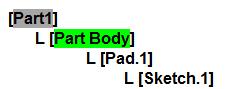
Every action you have taken in CATIA will be logged on the tree structure displayed on the screen. This is called the “specification tree” (仕様ツリー) and it looks like this:

Users will have to be conscious of this tree structure all the time because it will be important to know how the data was created. Visualizing the history like this allows a user or other users to modify the data when you need to. 

If the specification tree is not managed well, you or other people will be in trouble the next time you are at it. You might have to say, “Where the heck do I have to get back?? I can’t modify it!!” - It is almost like when you don't keep your room organized, and go to school in the morning leaving your locker room key at home. You call your mom from school later but she can't find it. She says your room is messy; she has no idea where to find it. Both you and your mom might be upset and you would ruin the day. (This is what my daughter did about a year ago ….)


Users/companies are always thinking about reducing the time of work and cut the cost. Being organized here on this specification tree is a very important factor to keep your modelling process more efficient and productive.


Feature/ Element (フィーチャー/ 要素):

In many cases, a 3D geometry will be created from a 2D sketch.

Let us create a geometry like this, for example.


This is how you create it:

1. Go to the [Sketcher] workbench.

2. Create a [Profile] like this in the [Sketcher] workbench.


3. The [Sketcher] workbench is intended to create 2D profiles only, so you will have to go to another workbench to make it 3-dimensional. Press the [Exit] icon.


4. When you exit the [Sketcher] workbench, you will be brought to either the [Generative Shape Design] workbench or the [Part Design] workbench. They are both capable of creating 3D geometries.


5. Let’s suppose you are in the [Part Design] workbench now. What you may want to do is create a 3D geometry by extruding the sketch you have just created.


In order to extrude a 2D sketch, select the [Pad] icon. (This icon exists only in the [Part Design] workbench.)


The specification tree will look like this:


Among the users of CATIA, the terms such as [feature] and [elements] are used quite often. In this case, [Pad.1] will be called a feature.


If you make a hole on this geometry, [Hole.1] will be added in the specification tree and it will also be called a feature (フィーチャー).


The specification tree, by the way, will be displayed like this:


There is not much to distinguish with it but a feature (including [Pad], [Hole], etc.) can also be called an element (要素).


Part/ Product (Assembly)

When multiple geometries will be created, they can be managed & treated as 1 [Part] file, or as 1 [Product] file (an assembly file) with multiple [Part] files in it.


[Example 1:]

If 2 geometries will be created and will be managed in 1 [Part] file, the specification tree will be displayed like this:


[Example 2:]

If 2 geometries will be created and be managed in 1 [Product] file with multiple [Part] files, the specification tree will be displayed like this:


[Example.1] and [Example.2] are two different things. They are more different than how they look.


#1. [Example.1] is 1 [Part] file, so only 1 file will be created. Because it is 1 [Part] file, it will be treated as if it were 1 single machine part, so even if there are many [Bodies] or [features] in it with multiple geometries, constraints (e.g. fixing, positioning with coincidence/ offset, or contacting) will not be applied in order to define relationships between one [Body] and other. But it is simpler than a [Product] file to save and manage data, since it is 1 single file. The [Save As] will be used to save data (just like MS Word or Power Point).


#2. [Example.2] shows that there is 1 [Product] file as the dominant product with 2 [Part] files under it. This means that 3 files (1 [Product] file and 2 [Part] files) will be created and will have to be managed. This sounds like bad news because you have to keep as many as 3 files instead of 1. - The good news, however, is that constraints (e.g. fixing, positioning with coincidence/ offset, or contacting) can be applied to these [Part] files in order to define relationships between one [Part] and other, so they will be treated like separate parts. 


For this reason, 1 [Part] file can be re-used independently if it is saved somewhere you determined. This way, you will be able to keep multiple [Part] files out there in order to manage them, and you may want to call it a parts catalog. The [Save As] command will not be used here because each file ([Product], [Part]) has to be saved with the save directory you will define respectively.

A [Product] structure (an assembly modelling) enables to be developed to kinematics (simple machanisms analysis).

Select the [Save Management] command to display the list of files that are open. In this example, the [Product] data contains 1 [Product] file and 2 [Part] files. Make sure that each file will need to have some items to be defined, such as a file name titled as [Name] and save directory titled as [Location].

May 14, 2012

[Be determined and confident] 腹を決め、自信を持って

People often (so very often) say that ever since the IT revolution has taken place, the world seems to have changed dramatically with a great speed. They also say that the speed has getting even faster along with the trend of “globalization” or “internationalization”. Living here in Japan, there is no single day that I don’t hear such a word. You can hear someone mentioning it on the morning train, in a park or a lobby when you eat lunch, or in a restaurant or a hospital you may visit.

So many people say, “It is so cool you guys speak 2 or 3 languages at home.” The way they say it is almost like they are envious for someone who succeeded in a diet to become skinnier, or the face has become to look younger.

I can’t imagine a life without speaking multiple languages. I like where I am now and I am proud of being bilingual. I think it is a great benefit for my 13-year-old daughter to live with two languages. She speaks Japanese with her Japanese friends, while using English in her school as well as at home.

I'm pretty sure, however, there will be a time when she takes it negatively about it. She might feel she belongs nowhere. It is true that my family and I feel we are different here in Japan, but we also feel the same way out there in America, too. - We are different anywhere.

When you start thinking about it, you might want to say, “It is a great tragedy!” They might imagine a situation where a spirit that has nowhere to go after its physical life, just like the “Wandering Hollander”. – But it is out of the point.

The point here is that it is not to feel inferior or superior, but to be determined to be able to accept this "in-between" status between one language (culture) and another. That is a process through which bilingual (bicultural) individuals will feel comfortable to stay where they are, and they take pride in it. – There were times when such people were really hard to live because there was more ignorance or discrimination existing than there is now today.

The globalized economy is even good news to those who are growing or have grown bilingually.

I have come to think of Darwinism. There is a key word “survival of the fittest” by Charles Darwin that describes that suitable ones will be preserved in the struggle for life. I am not saying that just bilingual individuals are the fittest, but the world has become to consider more of them.

This “In-between” position, therefore, will no longer be considered unstable, but could be a distinctive category where such people live more comfortably in order to make more possitive impact on society.

Apr 29, 2012

[Good Bye for Now, Toyota City. Hope I Will be Back Soon!!!]

I am packing my stuffs in my room at Toyota, Aichi. I have to leave this city for a family reason. The two years I spent in this place were the best career experience in my life. I was always thankful for being there, and being part of one of the greatest automakers in the world.

I worked so busily in the last day in the office. I worked on some technical support issue (it was not an easy one to handle) during the morning and somehow I made it to come up with a good thing to be a solution. I even had a translation request in the evening and I did it in a short time. I also had some more important things to do during the work hours I really appreciate I was able to work like that on the last day in that workplace. I went out to eat lunch with a couple of people in my group. I ate noodles with no soup and they were so good. It seemed like the farewell party conducted the previous day was still continuing. I was talking to some people in the office even after it was 6 p.m. I had a dinner with the leader. I truly hope I will have a chance to work with them again in the future. The culture out there is, by far, the best one I have ever been through. I am proud that I worked in that wonderful work environment, and I am proud of those great people still working out there. I am going to miss them and the work place. I want to say "Thank you so much" to all of those who concerned while I was here in Toyota city, Aichi.

Mar 12, 2012

[What is ISO26262? - Just curious]

NIKKEI ELECTRONICS is a business magazine written in Japanese. A good friend of mine here in Japan printed some 15 pages out and gave it me the other day. He did that for me because I had mentioned ISO26262 a little while back, saying “Do you know what that is all about? I’m just curious.”

The reason I was interested in this issue is because I happened to hear someone saying ISO26262 will be a mandatory package in order to sell vehicles in Europe. And I had also read from another magazine that some automakers and suppliers in Japan had not been ready for this. (I’m not exactly sure about the situation right now in February 2012.)

The following is a digest I made from the magazine article I read in Japanese. (NIKKEI ELECTRONICS, the 2011.1.10 issue)

Overview:
1. ISO26262 is a standard for systematic safety in electronic products of automobiles.
2. The reason it came into being is that another safety standard (IEC61508) had already been set out, but it was not suitable to evaluate. It was not practical.

IEC61508 vs. ISO26262:
IEC61508 was issued in 1999 in order to be a standard for electric and electronic fields. But it was not established to meet the requirements for automobile production. After some trials period, the article says, some automobile companies came to realize that IEC61508 was not suitable to implement in their automobile production systems.

[Reasons]
i) IEC61508 was originally issued for petroleum chemical plants. (It was not intended to evaluate the mass production system of automobiles.)
ii) Probabilistic theory has a lot to do with an evaluation for IEC61508. But it is out of the point.

Some automakers in Germany and France thought this standard wouldn’t work as expected, so that another one (ISO26262) should be created.

A CUSTOMIZED VERSION OF IEC61508?
So it might be natural to think ISO26262 is a customized version of IEC61508. But it is only a part of it. - ISO26262 is more like an enhanced version of IEC61508 in that another point of view was adopted besides just functional safety issues.

Problems with IEC61808:
Since IEC61808 was issued in 1999, some experts in safety measures have pointed out that it does not fit the automobile components production with the following reasons.

1. Relying on the probabilistic theory will be misleading. It may make the problem become more complex:
IEC61808 is focusing too much on the probabilistic theory in order to detect an error of an individual part. This will cause the functionality to be more complicated because an effort will have to be made to reduce the occurrence of errors. This will likely cause a problem to the whole system.

2. Part-to-part evaluation is not enough to prove safety:
Evaluation is conducted on the part-to-part level in IEC61508. Meaningful as it appears, it actually doesn’t fully prove the safety. Reliability and safety, the article says, are 2 different things. One part can have a different level of risk according to which other parts it will be associated with. Risk will not be generated from just one single part, but from multiple parts combined.

3. It is not practical:
In addition to #1 and #2, IEC61808 has another problem. It doesn’t have a concept to overview the system in order to evaluate safety. The probabilistic approach was criticized for having no academic reasoning or practicality.

Conclusion:
ISO26262 was created by referencing the system safety measure, and it was adopted in the aerospace and defense industries in the U.S. This approach has arisen and developed after the World War II. And it is more focused on macro-perspective regarding safety, where an interaction of subsystems will be evaluated. And that makes ISO26262 look differently from another existing standard, IEC61808.